Saturday, May 16, 2020

I Believe You Need Help

There is a dice game that my husband, Charles, and I like to play during our meals. It involves rolling six dice and hoping to gain points with ones, fives, or sets of triples. Normally the game is played until one reaches five or ten thousand points, but seeing as we play it so often, we decided to keep a continuous score tally until someone reached one hundred thousand. Charles had reached the game-ending score, leaving me with one more chance to pass his score and win. It would take a miracle though, and my dice had not been rolling well.

In my family, we grew up serious competitors in this game. The dice had roll-outs where we rolled all the dice from a large bag, selecting the best ones to play with based on the results. When dice "misbehaved" we put them in timeout. We scolded our dice, taught them, whispered to them our desired rolls and strategies, and even tried to sabotage the other players' dice by telling them to roll bad numbers. Sometimes they listened. Most times they didn't. But that was an easy matter--we would just put them in timeout and get new ones that would "listen."

The game was down to one final role--one last chance to beat Charles. Talking to my dice, Charles said, "I believe in you," to which I responded, also in reference to my dice, "I believe you need help."

Afterward, we discussed that little exchange. Often we are apprehensive about asking for help. To do so can seem like admitting some deficiency or defeat. Are we not strong enough? Good enough? Smart enough?

I have been married a week today. It's wonderful, exciting, and slightly terrifying. There are a lot of adjustments and a lot of sacrifices. At times it can seem overwhelming. But I remember the exchange over the dice and am reminded that the most beautiful thing about marriage is you get to face everything together. I believe that I can do this. I believe that I need help. I believe in my sweet husband. I believe he needs help, too. And isn't a beautiful thing that we can help each other?

Sometimes though that isn't enough. At such times we call upon outside help--family, friends, our Savior. Not because we can't do it, not because we're weak, but rather because we believe in us.

And believing in us means we are willing to get help and work through challenges. We believe we need help because we believe in us. As my husband and I discussed this concept, he remarked quite insightfully, "You know, that sounds a lot like the Savior: I believe in you. I believe you need help."

We know we need the Savior's help, and we know He came to help us. We also know that His offer of grace, rather than belittling His belief in us, is a testament of his firm belief in who we can become. So next time you find yourself needing help, don't think of it as a defeat or a disgrace. Rather, think of it as an opportunity to exercise belief in yourself and in the change and progress you can and will make--with a little help ;).


Sunday, August 25, 2019

Imposter's Syndrome and Answers to Prayer


While I was on my study abroad I had the opportunity to attend Shakespeare’s play Measure for Measure. It was one I had never read nor watched before and I was struck by one quote in which Lucio comes to tell Isabella that her brother is imprisoned and sentenced to death and that perhaps she can persuade the Duke to pardon her brother’s sentence. When she doubts her ability to do so, Lucio persuades her, saying, “Our doubts are traitors, and make us lose the good we oft might win, by fearing to attempt.”
It made me think of this past spring when I applied to intern for the Ensign magazine and the first information meeting I went to where I looked around at a room full of well-qualified applicants and, thinking I didn’t have a chance against one of them, almost got up and left.
I stuck through the meeting, but when I left I tucked the application in the back pocket of my folder, and while I can’t say I forgot about it, I didn’t do much with it either. Finally, after about a week of indecision I decided to apply, only to find out in my editing class that morning that due to a confusion on my part, I had missed the deadline.
Sometimes you don’t realize how much you want something until it’s out of your grasp. And I was beginning to realize, as I struggled to hide tears, that this was something I really wanted. By the time my friend Sarah arrived I had lost the battle with my composure and we went to a small, unused classroom nearby where she in her wisdom suggested we pray.
I had been so afraid to email the Ensign and ask for an application extension because I didn’t want to start off the application process which such a low mark, but I got off my knees determined to do so.
It wasn’t the first time a prayer had put me on this path. Backing up a couple months, I was trying to decide what position to apply for in my capstone editing class. The class would be producing a travel magazine and we each had to apply for a staff position. I was trying to decide whether or not to apply for managing editor and once again, I thought, there’s no way, and even if I got the position, how would I fulfill it?
The evening before the application was due my ministering brother, Matt, came over. We talked for a bit and then when he was getting ready to leave he asked me if he could leave me with a prayer. He asked whether there was anything specific he should pray for and I told him about the decision I had to make. During his prayer the answer was clear: I needed to apply.
Applying for and receiving the position of managing editor may have been the best thing I did in terms of preparing me for an internship with the Ensign. If nothing else it gave me some of that confidence I lacked. It also proved a great addition to my resume and gave me something to talk about in my interview, along with my job in which I researched and wrote articles for a religion professor at BYU.
That job came about by way of a disappointment that proved a tremendous blessing. I had been applying to the religious studies center to be a staff editor for their publications. I made it through the editing tests and interview and a few days later received a phone call. I had been one of the final two candidates for the position. They had gone with the other candidate. But, I was told by the hiring manager on the other end of the phone, my application was strong enough that he had taken the liberty of sending it out to the religious education faculty to see if they needed an assistant.
Though flattered, I was still rather disappointed.
Within a matter of hours, however, I received an email from one of the religious education professors, Sister Woodger. She wanted to interview.
Five minutes into the interview, I had a job.
I started out transcribing, then substantive editing, then copy, and finally writing. I helped write a chapter for her book on the beatitudes, then sections on her book on significant Church artifacts, finishing with a lengthy research paper on a notable figure in Church history.
In the meantime, I had decided to take a class on Christ and the Everlasting Gospel. It wasn’t necessary—I’d fulfilled the required credits for religious studies already—but had decided it couldn’t be a bad thing. Between my work for Sister Woodger and the journals and write-ups we were required to do weekly for my religion class, I had all I needed to draw on to compile  my portfolio for the Ensign application—something I certainly wouldn’t have found time to do otherwise.
The Ensign replied to my request for a deadline extension and in one afternoon, after returning home late from my ski class, I took the required spelling and editing tests, wrote some short essays of intent, and sent it all in.
Then came the waiting. I waited. And waited. And waited. It felt like eternity.
At last the call came in. I’d gotten the position. I was ecstatic!
But the story doesn’t end there.
Maybe you are familiar with the imposter syndrome. In late July it began to hit hard. I wouldn’t start for another month and a half, but just thinking about it I began to worry that they had picked the wrong candidate and that I would never be able to deliver on their expectations.
At the time I was on a study abroad trip in the British Isles and Ireland. We were in a beautiful coastal town in Wales (Llandudno) when I decided to go for a long walk up to the tops of some of the nearby seaside cliffs. It was early evening, but it was one of those long summer evenings where the sun seems to be merely in the act of setting long into the night.
Except for the sheep and some occasional mountain goats (and the hundreds of large slugs) I was alone. I took the opportunity to tell God how nervous I was starting to feel about my upcoming internship. I also told him that I still had no idea what I wanted to do when I graduated and that that was starting to worry me at least a little.
The breeze off the ocean had been sweeping up over the cliffs and hills quite rapturously, but the moment I prayed, the wind stopped and it was silent. I got up, and walked back to our hostel.
The next day was Sunday. We attended church in a small building with an even smaller congregation and when one of the speaker’s called in sick, one of our professors was asked to fill in. He shared how inadequate he feels at the start of each school year and how inadequate he felt when he started his Phd program.
He had taken a long break between his masters and Phd and his Phd program was a different subject area from his masters. When he came back from one of his classes having understood very little, his office mate asked him what was wrong and then remarked, “The faculty in this program know you. They saw your application. They interviewed you. They brought you here. They trust you to succeed.”
When my professor shared that I knew it was the answer to my prayer. I just hadn’t expected it to come so quickly! It was just what I’d needed to hear.
Afterward, I thanked him for his talk and he talked to me more about the internship (he had worked for the Church before and had a number of students work there as well) and I felt much more at peace about it.
While I had been up on the cliffs in Llandudno praying I’d had a very clear thought: God did not get you this far to let you fail.
If there is anything more certain than my not failing, it’s that God got me here. Just a few days ago while I was packing things up to move apartments I came across a small stack of papers: applications for the Ensign internship from as far back as my Sophmore year—all of them untouched. I’m so grateful that God finally helped me find the courage to apply.


I’m still nervous. But I am so excited to start this next adventure. All I can think of now is a quote that has sat on my desk for the past four years: What if I fall? Oh, but my darling, what if you fly?


Sunday, April 21, 2019

Thanks Be to God for His Unspeakable Gift

A couple weeks ago for my morning run I decided to run down to the cemetery. It was one of those days when the sky seems in mourning and the grass looks so green you wonder how it doesn't stain everything. As I ran I listened to an album I grew to love on my mission called the Lamb of God by Rob Gardner. My trainer played it for me on my first Sunday in the mission and from thence grew my obsession. But listening to it as I ran through the cemetery that morning, it took on a whole new meaning.

As I ran through the black iron gates the album was on The Lord's Supper. I found it ironic in a beautiful way that just as Christ had been preparing then to enter the garden, I was entering the cemetery. The song that soon followed was Gethsemane, in which the Savior is portrayed by a rich cello. You can hear the tears run down the strings, every note a swelling sob, every pause a sigh. One wonders why he had to suffer so much. But running past all the grave stones, row upon row, I saw why.


The song that follows is Peter's after he has denied thrice his Lord. It is one almost equal in anguish to the one before it. "Oh God!" he cries, "What have I done? As Thou has taken stripes for me, could I not take but one for Thee? I dare not look upon His face and see the very Son of God, His brow so bruised and stained with blood, His eyes that shed my sorrow's tears, and watch as all hope disappears. I will not watch them crucify my Lord!" And then at the climax of the song Peter cries out with both heartache and conviction, "For I know this man! I know Him! And when my eyes have closed in death, these words will hang on my last breath: I know Him." As I run past the gravestones I wonder how many knew him, and how many could have said so with Peter's conviction. But one thing is certain, there in the Garden he knew us all.

This Easter morning I got up early and went for a walk with a friend to the cemetery. We meandered through the grave stones before settling down in a pavilion where we listened to the song "I Am the Resurrection." When it came to the words "I am the Resurrection and the Life, he that believeth on me though he were dead, yet shall he live," a sweet spirit seemed to settle on the cemetery, and I saw what a wonderful gift his sacrifice was.

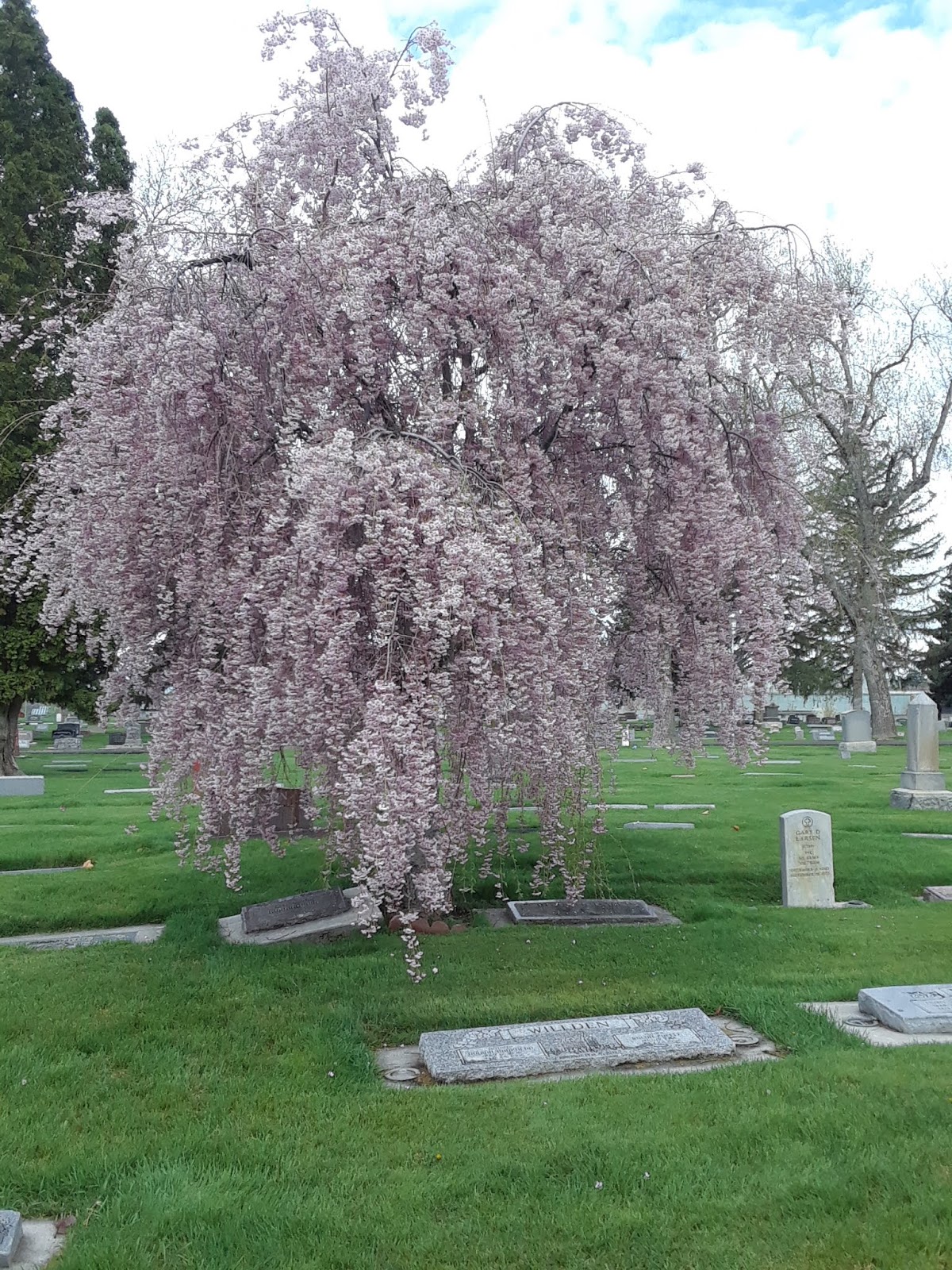
 As we were leaving the cemetery, my friend and I listened to the song of Mary when she sees the resurrected Christ. Listening to that song of hope and joy and looking around at the beautifully blossoming trees it seemed less to me like a cemetery and more like a Garden.


So many beautiful and central events that form the pillars of eternity happened in a Garden. In the Garden of Eden, Adam and Eve talked with God and made the choice that allowed them to have children and allowed us to come to earth and learn and grow and experience the joy of redemption. In the Garden of Gethsemane, our Savior suffered for our sins, trials, and weaknesses. And in a Garden outside an empty tomb, the resurrected Christ appeared to Mary, who, in all its symbolic beauty, thought Him to be the Gardener.


I cannot know the joy Mary must have felt to realize it was her Lord. But I do know the joy I feel to know that he is MY Lord. My Gardener. My Savior. And that over 2000 years ago today he rose again, bringing hope and life. I find comfort in the words of Paul, "O death, where is thy sting? O grave, where is they victory?" and Isaiah's resounding response, "He will swallow up death in victory; and the Lord God will wipe away tears from off all faces."

Thanks be unto God for his unspeakable gift.

Friday, March 1, 2019

Remembering Him


In his talk “This do in Remembrance of Me” Elder Jeffrey R. Holland discusses the sacred significance of the sacrament and the importance it should have to us. He speaks of it as the commemoration of the passover, when the blood of the lamb protected the ancient Israelites from the destroying angel. “How sacred and how holy is it? Do we see it as our passover, remembrance of our safety and deliverance and redemption? If remembering is the principal task before us, what might come to our memory when those plain and precious emblems are offered to us?”

The sacrament is the time to reflect and to remember—to remember Christ, his ministry, his miracles, and his atonement. This can be hard because for all of us, we have no primary memories of these experiences on which to draw. None of us were there when angels proclaimed to shepherds Christ’s birth. None of us where there when healed the leppers. None of us were there when he calmed the sea. And none of us were there when he suffered in the garden or on the cross. How then, do we remember what we never saw happen?

May I suggest that is the perfect time to remember instead the times that we felt the joy of the Gospel and redemption, that we remember the times that we were healed from illness or from spiritual and emotional pains, when Christ calmed the tumultuous seas that raged in our lives, and when we have felt of his forgiveness and grace that come because of his sufferings for us. It is wonderful to reflect on what we know of Christ from the Old and New Testaments, but when it comes to remembering, it is, in my opinion, even more impactful to remember our own experiences with him. As we think on these experiences, “we could—and should—remember the wonderful things that have come to us in our lives and that “all things which are good cometh of Christ” (Moro. 7:24). 

Additionally, we are told in 1 Corinthians 11:28 that we are to examine ourselves. Often I am inclined to dwell on my misgivings, short comings, and sins. But a full examination would look also at my progress. It would look at how I have improved since the previous week, and then at what I could do the coming week to continue in my efforts to come unto Christ and be perfected in him. 

As we think on the coming week, it’s appropriate to think of those close to us and how to serve them as well. “We could remember that Christ called his disciples friends, and that friends are those who stand by us in times of loneliness or potential despair. We could remember a friend we need to contact or, better yet, a friend we need to make. In doing so we could remember that God often provides his blessings through the compassionate and timely response of another. For someone nearby we may be the means of heaven’s answer to a very urgent prayer.”

In the very least, we can be the answer to one urgent request given by the Savior so many years ago to his three disciples on that night of deep anguish and grief, “Could ye not watch with me one hour?” (Matt. 26:40). I think he asks that again of us, every Sabbath day when the emblems of his life are broken and blessed and passed. “Could you not think of me, just in this moment?” When I picture the savior suffering in the garden, or when I picture him administering the broken bread to his disciples, or when I picture him inviting people to come and feel the marks in his hands and see him, I imagine and long for the moment that he would spend just with me. That moment that he would look into my eyes and know me. But even that moment can happen only if I, too, spend a moment with him, look deeply at my life for traces of him, and know him too. 

Monday, February 11, 2019

Love Everyone

I still remember in perfect clarity a moment from almost 6 years ago. I was sitting in a counselor’s office and we had been talking about love and relationships when she asked me, “Do you love me?” I thought for a moment. I didn’t really like her. But I did love her. “Yes,” I responded, “I love everyone.” The counselor seemed a little taken aback, and then she challenged it as though such a claim weren’t possible. And it left me wondering, “Do I—could I—really love EVERYONE?”

The answer is an emphatic yes. Yes, I can. But I can see where my counselor was coming from. Loving, in our difficult and convoluted world, isn’t always easy. Said Elder Robert D. Hales, “Our Savior’s command to love one another as He loves us is probably our greatest challenge.” But that Christ-like love is also our “greatest need.”

In 2 Timothy 2:3 we are told that “in the last days, perilous times shall come.” These are the last days. And they are certainly perilous. These are the days when Satan is his putting forth his final, urgent fight. We are told, too, that in these last days men will be found “without natural affection” and that “the love of men shall wax cold.” In Matthew we read that it is because iniquity shall abound that love will wax cold. While this may be true, I believe the greater lesson is in its inverse: because love will wax cold, iniquity will abound.

In his talk “Christian Courage: The Price of Discipleship” Elder Hales emphatically stated, “[God’s] love . . . is the only power that can subdue the adversary.” It is by simple, courageous acts of love that we make Satan quake and tremble as we bring heaven closer. As President Nelson stated in a recent address, “Our doctrine is not complicated, convoluted, or complex. It is so simple—love God and love your neighbor.” Love EVERYONE.